AutoCAD: Lineweights

Lineweight is the visual thickness of lines. The use of lineweight is critically important to maintaining good legibility and professional appearance in drawings. See this post for general information on lineweight.

In AutoCAD, lineweight is an object property, meaning that every object in an AutoCAD drawing can be assigned its own lineweight. By default, every object is assigned the ByLayer lineweight, meaning that the object assumes the lineweight assigned to its layer. Like any object property, this can be overridden on an object-by-object basis.

It’s considered good practice to use layers to organize object lineweight, rather than setting object lineweight on a per-object basis. In other words, unless there is a compelling need to do otherwise, always keep AutoCAD object lineweight set to ByLayer.


TO CHANGE LINEWEIGHT OR LINETYPE ON A BYLAYER BASIS:

1.     Load a linetype into your drawing. (See above.)

2.     Type LAYER to bring up the Layer Properties Manager palette.

3.     Click on the layer whose properties you wish to change.

4.     Choose the desired linetype or lineweight. All objects in this layer with the BYLAYER property set for linetype or lineweight will inherit these settings.


AutoCAD: Selection

Many AutoCAD commands will prompt you to Select objects. The following are acceptable methods of responding to the Select objects prompt. Each time you add an object to the selection set, it is highlighted (i. e. it appears dashed). When you are finished selecting objects using any one or a combination of these methods, press [Enter] to continue the original command.


TO SELECT OBJECTS:

Click on objects one-at-a-time.

OR draw a window around the object(s). AutoCAD uses a click-click method to define a selection window, rather than the standard click-drag-release. “Standard” selection windows are drawn from left to right, and select only those objects completely within the window. “Crossing” windows are drawn from right to left, and select all objects within and contacted by the window.

crossing_standard_01

OR type F (for Fence), and draw a selection line (a “fence”). Like a crossing window, a fence selects any objects it touches. This method is useful for making precise selections in restricted areas.

OR type P (for Previous). This selects whatever object or objects were previously selected.

OR type L (for Last). This selects whatever individual object was last selected or created.

OR type U (for Undo). Deselects the last object(s) selected. Use this if you make a mistake while defining a complex selection set.

OR type ALL. Selects everything in the current space.

OR type R (for Remove). Switches the selection mode from “adding” to “removing”. Type A (for Add) to switch back. Use this function while defining a complex selection set.


PRESELECTING OBJECTS:

It is possible to preselect objects before issuing commands. This technique is frequently useful in 3D (three-dimensional) work, but it can be used in 2D as well.

To preselect an object or objects, click [esc] two or three times in succession, and then either click on objects one at a time or window several objects at once. As you preselect more objects, they display highlighted (i. e. dashed) with grips. Grips are like “handles” at object corners and other critical points. You can click on highlighted grips to stretch and move objects.

After an object has been preselected, you can issue any modifying command (such as ERASE, MOVE, COPY, etc.).

To clear preselected objects from the selection set, click [esc] two or three times in succession.

AutoCAD: Commonly Used Commands

AutoCAD is a command-driven software application, meaning that it responds to commands typed after the Command prompt at the bottom of the screen. Commonly used commands (and equivalent keyboard shortcuts) are as follows:


LINE (L): The LINE command draws straight lines between specified points. The command will keep prompting you to enter points until you terminate the command by clicking the esc key (or by clicking Enter without indicating a point).
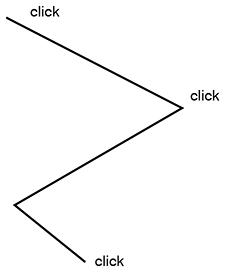
line_01

Hint: Use the [F8] key to restrict lines to orthogonal directions.

Ribbon: Home > Draw > Line


ERASE (E): The ERASE command erases objects. The command will prompt you to select objects.

Ribbon: Home > Modify > Erase


PAN (P): PAN has the same effect as clicking on the scroll bars at the edge of the window, or holding down the center mouse wheel and moving the mouse.

Hint: Every once in a while, AutoCAD will prevent you from panning your view too far in one direction; the screen will “stick”. To get around this, click esc a few times in succession, and then type RE (for Regenerate). This forces AutoCAD to regenerate the drawing display, expanding the area over which you can pan.

Note: To invoke a “legacy” version of the PAN command, type -PAN (hyphen PAN) or -P. This is a useful and more precise variation of the command; it operates analogously to MOVE.

Ribbon: View > Navigate 2D > Pan


ZOOM (Z):  ZOOM works like a magnifying glass; use it to enlarge or reduce the apparent size of the drawing. Note that ZOOM does not change the actual size of the drawing – just its appearance. Typing ZOOM at the command prompt, and then choosing the Realtime option, has the same effect as spinning the mouse wheel.

Hint: As with the PAN command, AutoCAD will occasionally prevent you from zooming your view too far in or out. If this happens, click esc a few times in succession, and then type RE (for Regenerate). Ultimately, there are limits to how far you can zoom in or out (try and find these).

Hint: Typing Z, for Zoom, followed by E, for Extents (that is: Z-enter-E-enter), causes AutoCAD to zoom out to the full extents of your drawing. Z-enter-A-enter has a similar (though not identical) effect.

Ribbon: View > Navigate 2D > Zoom


MOVE (M): The MOVE command moves objects, translating them from one point to another. The command prompts you to select objects, and then it prompts you for a base point. The base point can be any point in the drawing, not necessarily on the objects being moved. The command then asks for a second point (a displacement point). The objects are erased from their original location.

move_01

Ribbon: Home > Modify > Move


COPY (CO): The COPY command differs from ctrl-C in that it includes a “Paste”-like operation. COPY is fundamentally the same as the MOVE command except that the original objects are not erased from their original location. Also, COPY allows you to make multiple copies at one time: to do this, type M after you’ve completed selecting objects.

copy_02

Ribbon: Home > Modify > Copy (different than using ctrl-C to copy)


TRIM (TR): Use the TRIM command to “cut” an object with another object. For example, two non-parallel lines can be used to cut each other. The command will prompt you to select “cutting edges” (you can select as many edges as you want). After you’ve selected edges, the command will prompt you to select the objects to trim. Click on the part of the object you want to have disappear.

trim_01

Hint: When selecting objects, type ALL, or simply press enter at the first prompt to select objects. Then, when selecting objects to trim, every object in the drawing can potentially trim every other object in the drawing.

Hint: Type EDGEMODE at the Command prompt to switch between two different settings (0 or 1): when set to 0, objects must be in contact to trim one another.

Hint: When selecting objects to trim, type F (for Fence). See section 1.4 for more on this.

Hint: When using the TRIM command, hold down the Shift key to change its function to EXTEND.

Ribbon: Home > Modify > Trim


EXTEND (EX): EXTEND is the “reverse” of TRIM. The command prompts you to select “boundary edges” (you can select as many edges as you want). After you’ve selected edges, the command will prompt you to select the objects to extend. Click on the part of the object you want to extend.
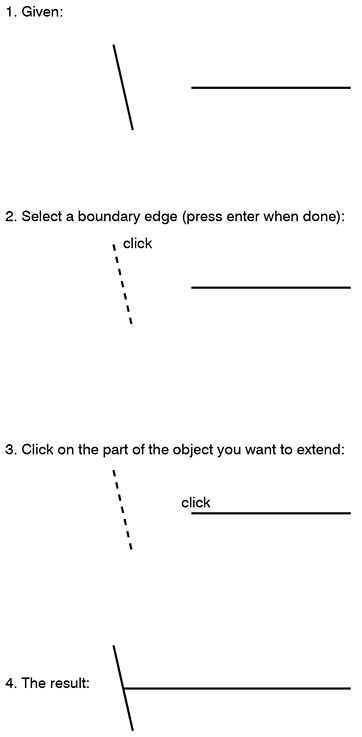
extend_01

Hint: When using the EXTEND command, hold down the Shift key to change its function to TRIM.

Ribbon: Home > Modify > Extend


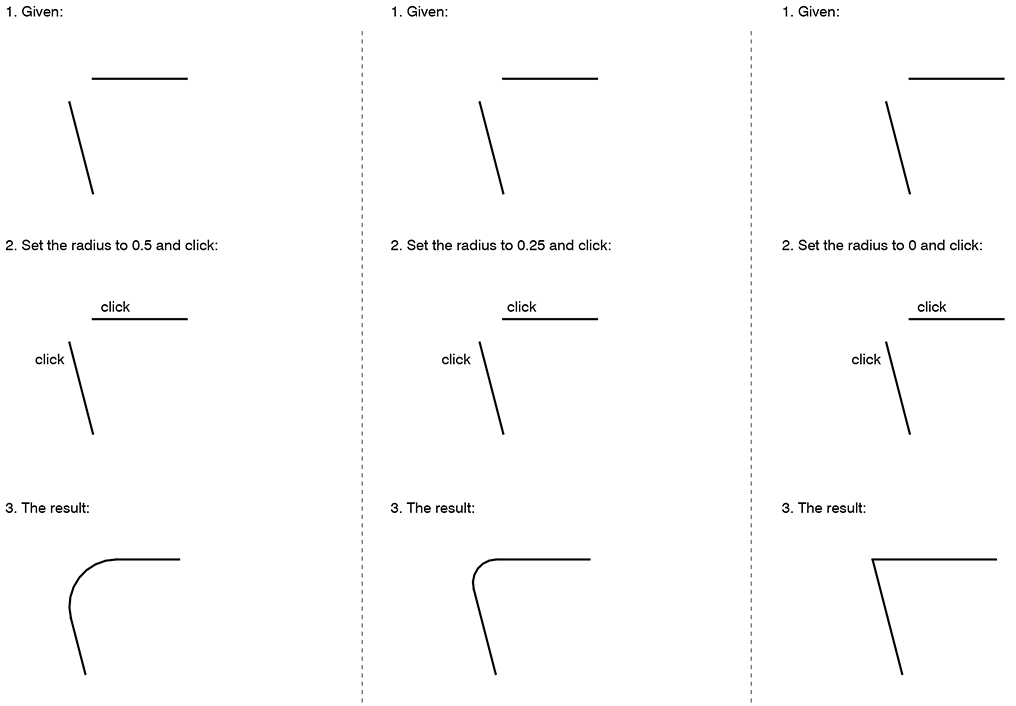
FILLET (F): The FILLET command can be differently understood as a combination of the functions of EXTEND and TRIM, and/or as a means of providing rounded connections between lines. The command always operates on two independent objects. Its operation is constrained by its radius setting. (To change the fillet radius, type FILLET, and then type R for radius.)

fillet_01

Ribbon: Home > Modify > Fillet


CIRCLE (C): CIRCLE draws circles by one of several methods, e. g. the default center-radius method.

circle_01

Hint: Sometimes, AutoCAD will temporarily display circles as polygons (octagons are common substitutes). This is a time-saving device built into the program. To display the circles correctly, type RE (for Regenerate).

Ribbon: Home > Draw > Circle


ARC (A): ARC draws arcs by one of several methods. When using the center-start-end method, note that arcs are drawn counterclockwise.

Hint: Sometimes, AutoCAD will display arcs as line segments. To display the arcs correctly, type RE (for Regenerate).
Ribbon: Home > Draw > Arc


OFFSET (O): OFFSET is used to create parallel lines and concentric curves. It operates on one object at a time. The general procedure is: type OFFSET; click on the object; specify a distance; finally, click off to one side of the object (e. g. left side or right side, top or bottom).

offset_01

Ribbon: Home > Modify > Offset


TEXT (DT) and MTEXT (T). The TEXT and MTEXT commands are used to add text to drawings. TEXT adds text one line at a time; MTEXT operates more like a word processor, with greater control over editing. Both commands are subject to the settings in the STYLE command: use STYLE to set basic attributes for fonts.

Important: When you use the STYLE command to define a New Style, it’s usually a good idea to define the style to have a text height of 0. This ensures that AutoCAD will prompt you to enter a text height every time you try to add TEXT or MTEXT.

Ribbon (TEXT): Annotate > Single Line Text
Ribbon (MTEXT): Annotate > Multiline Text


MIRROR (MI): MIRROR is used to create a “reflection” of existing objects around a line. Define this line with any two points in the drawing.

Ribbon: Home > Modify > Mirror


ROTATE (RO): ROTATE will rotate any selection set of objects around a fixed point. Note that AutoCAD measures degrees counterclockwise, with “0 degrees” corresponding to a “3 o’clock” position.

Ribbon: Home > Modify > Rotate


SCALE (SC): Use SCALE to enlarge or reduce any selection set of objects by a specified scale factor with reference to a fixed point.

Ribbon: Home > Modify > Scale


BLOCK (B): Creates a “block” (collection of objects with an insertion point).

Ribbon: Home > Block > Create


EXPLODE (X): Explodes blocks into their constituent parts.

Ribbon: Home > Modify > Explode


3D-ORBIT (3DO): Rotates the view in 3D space.

Ribbon: View > Navigate > Orbit


What is AutoCAD?

AutoCAD is a commonly used vector drawing application. Vectors include lines, arcs, and other geometry.

AutoCAD is a command-driven software application, meaning that it responds to commands (like LINE and ERASE) typed after the Command prompt at the bottom of the screen. AutoCAD has a ribbon, tabs, panels, and toolbars, but these are just alternative means of issuing typed commands. Since most of the commands have one- or two-letter shortcuts (L for LINE, E for ERASE, etc.), it’s usually much faster to type commands than to use the ribbon or toolbars.

AutoCAD has a long history in the architecture and design professions and continues to be used extensively for 2D (drafting) and 3D (modeling) work.

Its native .dwg file format can be read by most contemporary CAD applications (including Rhino, Revit, and SketchUp).

See:

forums.augi.com/forumdisplay.php?176-AutoCAD for a forum discussion.

Step-by-Step: 2D Projections in Rhino

Rhino models can be “projected” into 2D line drawings for use in presentations or construction documentation.

A 2D PROJECTION WORKFLOW:

1.  Open a Rhino model.

2.  Set the view you wish to project (e. g., a perspective view or an orthogonal projection like a plan or elevation).

3.  Enable a clipping plane if required. (See information on CLIPPINGPLANE.)

4.  Type MAKE2D [Enter].

5.  Select the objects you wish to project. Press [Enter] when done.

6.  In the 2-D Drawing Options dialog box, select Current View. Choose other options as appropriate for your situation. (For example, if you check Maintain Source Layers, the resulting 2D drawing will be organized according to the same layering scheme as your Rhino model.)

7.  Click OK.

8.  Although you may or may not see the result of the MAKE2D command on your screen, Rhino has created new objects representing a 2D vector projection of the objects you selected above. Before doing anything else, immediately choose File > Export Selected.

9.  Select the .dwg file format and save the drawing.

10.  After the drawing is saved, immediately click Delete. (This erases the projected geometry in Rhino and allows you to proceed with modeling.)

11.  The resulting .dwg file can be opened in AutoCAD and checked for scale, layers, etc. It can be dimensioned and saved in AutoCAD and/or opened in Illustrator for further editing and annotation.

Step-by-Step: 2D AutoCAD to Rhino

Two step-by-step methods for moving from 2D AutoCAD drawings to Rhino:


IMPORT/EXTRUDE METHOD:

This method begins with a set of pre-drawn AutoCAD plans, although the plans could also be drawn directly in Rhino using 2D drawing commands.

1.  Import the AutoCAD drawings to Rhino. [Type IMPORT.]

2.  Create a new layer for the plan drawings. Group the imported drawings into this new layer. [Type LAYER; create a new layer; select objects; type CHANGELAYER.]

3.  Create another new layer for new walls.

4.  Make sure OSNAP is turned on (toolbar at the bottom of the screen). Check END to lock to endpoints.

5.  Invoke the POLYLINE command to trace the wall surfaces from the AutoCAD drawings. (Alternatively, create the wall surfaces as polylines in AutoCAD prior to import.)

6.  Invoke the EXTRUDECRV (“Extrude Curve”) command to extrude the walls to their proper height.

7.  Invoke the CAP command to close the top and bottom of the extruded walls.

8.  Use the BOOLEANDIFFERENCE command to “subtract” openings from the walls.


IMPORT/CONSTRUCT METHOD:

This method begins with a set of pre-drawn AutoCAD plans, although the plans could also be drawn directly in Rhino using 2D drawing commands.

1.  Import the AutoCAD drawings to Rhino. [Type IMPORT.]

2.  Create a new layer for the plan drawings. Group the imported drawings into this new layer. [Type LAYER; create a new layer; select objects; type CHANGELAYER.]

3.  Create another new layer for new walls.

4.  Make sure OSNAP is turned on (toolbar at the bottom of the screen). Check END to lock to endpoints.

5.  Use the BOX command to construct boxes of correct height and size on the AutoCAD drawings.

6.  Use the BOOLEANUNION command to join separate walls together.

7.  Use the BOOLEANDIFFERENCE command to “subtract” openings from the walls.

Rhino: Importing and Exporting

TO EXPORT A MODEL OR DRAWING FROM RHINO:

Choose File > Export Selected or File > Export With Origin to save information in AutoCAD, Illustrator, Sketchup, .stl, and many other file formats.

File > Export With Origin is useful if you want to keep models registered (i. e., correctly aligned) between two or more software applications.


TO IMPORT A MODEL OR DRAWING TO RHINO:

To import a model means to place it within an existing model. Choose File > Import to import an existing digital model or drawing (AutoCAD, Illustrator, SketchUp). Make sure to select the correct file type.

You can also use File > Open to open an existing digital model in Rhino. Make sure to select the correct file type.

NOTE: Rhino will not directly open or import a Revit model. To open or import Revit information to Rhino, use AutoCAD as an intermediary.